

Global Cold Plasma Food Processing Market Led by Europe, Nordson, Enercon, Apyx Drive Innovation Growth
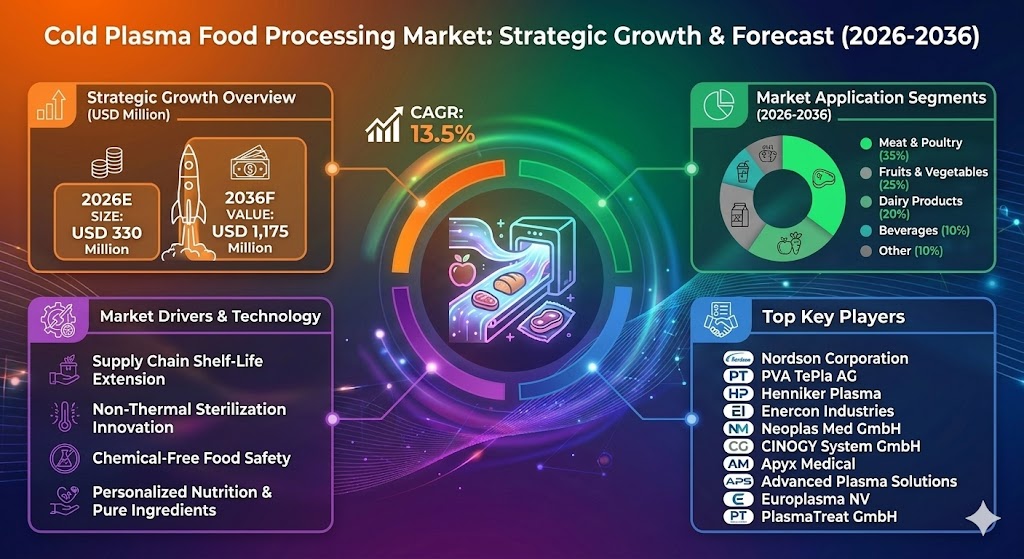
Cold Plasma Food Processing Market grows with demand for non-thermal preservation, enhanced food safety, and extended shelf life solutions.
ROCKVILLE, MD, UNITED STATES, April 9, 2026 /EINPresswire.com/ -- According to Fact MR, latest analysis, the global cold plasma food processing market is transitioning from pilot-scale innovation to commercial deployment, valued at USD 290 million in 2025 and projected to reach USD 330 million in 2026. The market is expected to expand significantly to USD 1,175 million by 2036, registering a strong CAGR of 13.5% and creating an incremental opportunity of USD 845 million.This growth reflects a structural shift toward non-thermal, chemical-free food processing technologies, enabling enhanced microbial safety while preserving food quality, texture, and nutritional value.
Get detailed market forecasts, competitive benchmarking, and pricing trends: https://www.factmr.com/connectus/sample?flag=S&rep_id=14681
Quick Stats
Market Size (2025): USD 290 million
Market Size (2026): USD 330 million
Forecast Value (2036): USD 1,175 million
CAGR (2026–2036): 13.5%
Incremental Opportunity: USD 845 million
Leading Technology: Dielectric Barrier Discharge (36% share)
Leading Application: Food Surface Decontamination (28% share)
Leading Region: Asia-Pacific
Key Players: Nordson Corporation, PVA TePla AG, PlasmaTreat GmbH, Enercon Industries, Henniker Plasma
Executive Insight for Decision Makers
The market is witnessing a technology-driven transformation, where food processors are shifting from traditional thermal and chemical methods to advanced non-thermal sterilization solutions.
Strategic Shift: From heat-based processing to precision plasma-based decontamination
Action Points:
Invest in plasma system integration within processing lines
Strengthen validation and compliance frameworks
Focus on scalable, high-throughput plasma systems
Risk of Inaction: Companies risk falling behind regulatory standards and losing competitive advantage in food safety innovation
Market Dynamics
Key Growth Drivers
Increasing regulatory focus on food safety and microbial reduction
Rising demand for non-thermal preservation technologies
Growing need for chemical-free sterilization methods
Expansion of packaged and ready-to-eat food production
Key Restraints
High capital investment for plasma equipment
Integration complexity within existing processing systems
Limited awareness and validation across diverse food categories
Emerging Trends
Adoption of atmospheric plasma systems for continuous processing
Integration of plasma technology in packaging sterilization
Development of multi-functional plasma systems (decontamination + residue reduction)
Increasing R&D in plasma-treated fresh produce and proteins
Segment Analysis
Leading Segment: Dielectric Barrier Discharge (DBD) technology holds ~36% share, driven by compatibility with industrial processing lines
Fastest-Growing Segment: Packaging sterilization and ready-to-eat food applications
Breakdown:
By Technology: DBD, plasma jets, corona discharge
By Application: Surface decontamination (28%), shelf-life extension, packaging sterilization
By Food Category: Fruits & vegetables, meat, seafood, dairy, ready-to-eat foods
Strategic Importance: Segments enabling continuous processing and regulatory compliance are critical for large-scale adoption.
Supply Chain Analysis (Who Supplies Whom)
Raw Material/Input Suppliers: Electrical components, gas suppliers (argon, air), and system components
Technology Providers: Plasma system manufacturers such as Nordson and PVA TePla
System Integrators: Engineering firms integrating plasma units into food processing lines
Distributors: Industrial equipment distributors and food technology solution providers
End-Users:
Food processing companies
Packaging manufacturers
Fresh produce exporters
Flow: Component suppliers → Plasma system manufacturers → Integration partners → Food processors → Retail/consumers
Who Supplies Whom: Plasma equipment providers supply processing systems to food manufacturers, who deploy them for microbial reduction and shelf-life enhancement before distributing products through retail channels.
Pricing Trends
Pricing follows a premium capital equipment model
Influenced by:
System complexity and customization
Installation and validation costs
Regulatory compliance requirements
Margins: High for technology providers; moderate for integrators; cost-sensitive for end-users
Regional Analysis
Top 5 Countries by CAGR (2026–2036):
China – 15.1%
India – 14.6%
United States – 13.2%
Germany – 12.4%
Japan – 11.8%
Regional Insights:
Asia-Pacific: Fastest-growing region due to modernization of food processing infrastructure
North America: Strong adoption driven by regulatory compliance and food safety standards
Europe: Advanced technology integration supported by strict hygiene regulations
Developed vs Emerging Markets:
Developed markets focus on efficiency and regulatory compliance
Emerging markets prioritize capacity expansion and technology adoption
Competitive Landscape
Market Structure: Moderately fragmented
Key Players:
Nordson Corporation
PVA TePla AG
PlasmaTreat GmbH
Enercon Industries
Henniker Plasma
Neoplas Med GmbH
CINOGY System GmbH
Apyx Medical
Advanced Plasma Solutions
Europlasma NV
Competitive Strategies:
Development of advanced plasma generation technologies
Expansion of industrial integration capabilities
Focus on application-specific solutions
Strategic partnerships with food processing companies
Strategic Takeaways
For Manufacturers:
Invest in scalable and efficient plasma systems
Strengthen R&D for diverse food applications
For Investors:
Target companies with proprietary plasma technologies and strong regulatory alignment
For Marketers/Distributors:
Highlight food safety benefits and sustainability advantages
Build partnerships with large-scale food processors
Future Outlook
The market is set to evolve into a mainstream food safety solution, driven by:
Increasing regulatory mandates
Rising demand for fresh-like, minimally processed foods
Advancements in plasma engineering and automation
Cold plasma technology will play a critical role in next-generation food processing ecosystems.
Conclusion
The global cold plasma food processing market is entering a high-growth phase, underpinned by technological innovation and regulatory alignment. Companies that prioritize scalability, integration, and compliance will be best positioned to capitalize on this emerging opportunity.
Why This Market Matters
Cold plasma food processing represents a breakthrough in food safety, offering efficient, chemical-free, and non-thermal solutions that align with evolving consumer preferences and regulatory requirements, making it a pivotal technology for the future of the global food industry.
Unlock 360° insights for strategic decision making and investment planning: https://www.factmr.com/checkout/14681
To View Related Report:
Non-PHO Emulsifiers Market https://www.factmr.com/report/736/non-pho-emulsifiers-market
Oriental Sauce Market https://www.factmr.com/report/738/oriental-sauce-market
Sour Sugar Market https://www.factmr.com/report/743/sour-sugar-market
Choline Market https://www.factmr.com/report/744/choline-market
About Fact.MR
Fact.MR is a global market research and consulting firm, trusted by Fortune 500 companies and emerging businesses for reliable insights and strategic intelligence. With a presence across the U.S., UK, India, and Dubai, we deliver data-driven research and tailored consulting solutions across 30+ industries and 1,000+ markets. Backed by deep expertise and advanced analytics, Fact.MR helps organizations uncover opportunities, reduce risks, and make informed decisions for sustainable growth.
S. N. Jha
Fact.MR
+ +1 628-251-1583
sales@factmr.com
Legal Disclaimer:
EIN Presswire provides this news content "as is" without warranty of any kind. We do not accept any responsibility or liability for the accuracy, content, images, videos, licenses, completeness, legality, or reliability of the information contained in this article. If you have any complaints or copyright issues related to this article, kindly contact the author above.
