

Automotive LED Lighting Market to Reach US$ 21.7 Billion by 2033 at 7.5% CAGR | Persistence Market Research
Automotive LED Lighting Market
Growing adoption of advanced vehicle lighting systems, safety regulations, and electric vehicles drives strong market expansion through 2033.
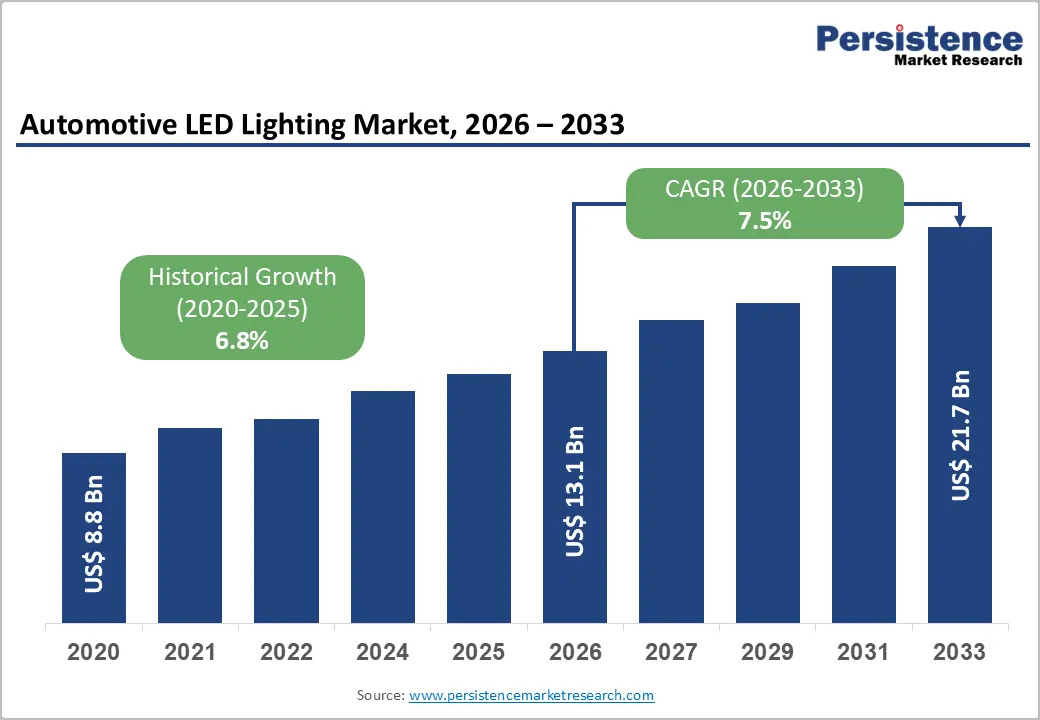
BRENTFORD, LONDON, UNITED KINGDOM, June 22, 2026 /EINPresswire.com/ -- The global Automotive LED Lighting Market is witnessing strong growth as vehicle manufacturers increasingly adopt energy-efficient and advanced lighting technologies. LED lighting systems have become a critical component in modern vehicles due to their superior brightness, longer lifespan, lower energy consumption, and enhanced safety performance. The market is valued at US$12.4 billion in 2026 and is projected to reach US$21.7 billion by 2033, expanding at a CAGR of 7.5% during the forecast period. Rising demand for advanced automotive lighting solutions and growing integration of intelligent lighting systems are supporting market expansion across passenger and commercial vehicles worldwide.
Stringent vehicle safety regulations and the accelerating adoption of electric vehicles are among the primary growth drivers for the automotive LED lighting industry. Regulations such as UN ECE Regulation No. 48 and FMVSS 108 are encouraging manufacturers to implement advanced adaptive lighting technologies. Passenger cars account for the largest application segment with a 68% share, reflecting strong consumer demand for safety and premium vehicle features. Asia Pacific leads the market with a 35% share due to its extensive automotive manufacturing base, growing vehicle production, and increasing adoption of advanced automotive technologies across the region.
👉 𝐆𝐞𝐭 𝐅𝐫𝐞𝐞 𝐒𝐚𝐦𝐩𝐥𝐞 𝐍𝐨𝐰: https://www.persistencemarketresearch.com/samples/35259
Quick Stats
• Historical Market Value (2020): US$8.8 Bn
• Current Market Value (2026): US$13.1 Bn
• Projected Market Value (2033): US$21.7 Bn
• CAGR (2026-2033): 7.5%
• Incremental Opportunity: US$8.6 Bn
• Leading Region: Asia Pacific, 35% share
• Dominant Application: Passenger Car, 68% share
• Top-ranking Product: LED Technology, 62%
Market Segmentation
Application
• Front
• Rear
• Side
• Interior
Technology
• Halogen
• Xenon/HID
• LED
Vehicle Type
• Passenger Car
• Light Commercial Vehicle
• Heavy Commercial Vehicle
Sales Channel
• OEM
• Aftermarket
Region
• North America
• Europe
• East Asia
• South Asia and Oceania
• Latin America
• Middle East and Africa
Report Highlights
• Market Forecast and Trends
• Competitive Intelligence & Share Analysis
• Growth Factors and Challenges
• Strategic Growth Initiatives
• Pricing Analysis & Technology Roadmap
• Future Opportunities and Revenue Pockets
• Market Analysis Tools
👉 𝐑𝐞𝐪𝐮𝐞𝐬𝐭 𝐅𝐨𝐫 𝐂𝐮𝐬𝐭𝐨𝐦𝐢𝐳𝐚𝐭𝐢𝐨𝐧: https://www.persistencemarketresearch.com/request-customization/35259
Regional Insights
North America
North America remains an important market for automotive LED lighting due to increasing demand for advanced vehicle safety technologies. Automotive manufacturers in the region are focusing on integrating intelligent lighting systems that improve visibility and driver safety. Growing electric vehicle adoption is further supporting market growth across North America.
Europe
Europe continues to experience strong demand for automotive LED lighting systems driven by strict vehicle safety standards and technological innovation. The region's automotive manufacturers are investing heavily in adaptive lighting solutions and energy-efficient vehicle technologies. Rising focus on premium vehicle features is contributing to LED lighting adoption across European markets.
Asia Pacific
Asia Pacific leads the global Automotive LED Lighting Market with a 35% share. The region benefits from strong automotive manufacturing capabilities, increasing vehicle production, and growing consumer demand for advanced automotive technologies. Expanding electric vehicle production and rising investments in automotive innovation continue to support regional market growth.
Market Drivers
One of the primary drivers of the Automotive LED Lighting Market is the implementation of stringent vehicle safety regulations worldwide. Regulatory frameworks such as UN ECE Regulation No. 48 and FMVSS 108 require advanced lighting systems that improve road visibility and driver awareness. These standards are encouraging automakers to adopt sophisticated LED lighting solutions across vehicle categories.
Another significant growth factor is the rapid transition toward electric vehicles. LED lighting consumes less power compared to conventional lighting technologies, helping reduce battery load and improve vehicle efficiency. As electric vehicle production continues to increase globally, demand for energy-efficient LED lighting systems is expected to rise significantly. The combination of energy savings and advanced functionality is creating strong market momentum.
Market Opportunities
The increasing demand for smart and connected vehicle technologies presents substantial opportunities for the Automotive LED Lighting Market. Automakers are integrating intelligent lighting systems capable of adapting to road conditions, weather environments, and traffic situations.
Growing demand for premium vehicle aesthetics also creates new opportunities for market participants. Consumers increasingly prefer vehicles equipped with modern lighting designs that enhance appearance and functionality. As automotive manufacturers continue developing innovative LED technologies, opportunities for product differentiation and market expansion are expected to increase across global markets.
Companies Covered in Automotive LED Lighting Market
• UFI Filters
• Koito Manufacturing Co., Ltd.
• Valeo SE
• FORVIA HELLA
• Stanley Electric Co., Ltd.
• Marelli Holdings Co., Ltd.
• Osram Automotive (ams-OSRAM)
• Lumileds Holding B.V.
• Nichia Corporation
• Gentex Corporation
• Ichikoh Industries, Ltd.
• ZKW Group (LG Electronics)
👉 𝐁𝐮𝐲 𝐍𝐨𝐰: https://www.persistencemarketresearch.com/checkout/35259
FAQ's
➤ What are the main factors influencing the Automotive LED Lighting Market?
Stringent safety regulations and increasing electric vehicle adoption are the primary market drivers.
➤ Which companies are the major sources in this industry?
Major companies include Koito Manufacturing, Valeo SE, FORVIA HELLA, Stanley Electric, and Osram Automotive.
➤ What are the market's opportunities, risks, and general structure?
The market offers opportunities in smart lighting technologies while facing challenges related to higher implementation costs.
➤ Which of the top Automotive LED Lighting Market companies compare in terms of sales, revenue, and prices?
Leading participants include Koito Manufacturing, Valeo SE, FORVIA HELLA, Marelli Holdings, and Lumileds Holding.
➤ What does a business area's assessment of agreements, income, and value implicate?
It highlights market growth potential, investment opportunities, and competitive positioning across regional and application segments.
Future Opportunities and Growth Prospects
The Automotive LED Lighting Market is expected to maintain strong growth through 2033, supported by increasing electric vehicle production, advanced vehicle safety requirements, and continuous innovation in automotive lighting technologies. Rising demand for intelligent lighting systems, premium vehicle features, and energy-efficient solutions will continue creating substantial opportunities for manufacturers and technology providers worldwide.
Explore the Latest Trending Research Reports:
Rail Fasteners Market
ADAS Sensors Market
Persistence Market Research
Persistence Market Research Pvt Ltd
+1 646-878-6329
email us here
Visit us on social media:
LinkedIn
Instagram
Facebook
YouTube
X
Legal Disclaimer:
EIN Presswire provides this news content "as is" without warranty of any kind. We do not accept any responsibility or liability for the accuracy, content, images, videos, licenses, completeness, legality, or reliability of the information contained in this article. If you have any complaints or copyright issues related to this article, kindly contact the author above.
